

Lines of Knowledge Generation and Application
As a research group that seeks to integrate all areas of knowledge, the areas of specialization of its members are grouped into a series of general and broad transdisciplinary Lines of Knowledge Generation and Application (LKGA), which are described and broken down further below.
LKGA 1: Physical, mathematical and numerical modeling of systems
The LKGA of "physical, mathematical and numerical modeling of systems" is the cornerstone of the laboratory, as it provides its services as the foundation and theoretical support for all technology development activities in the Transdisciplinary Laboratory
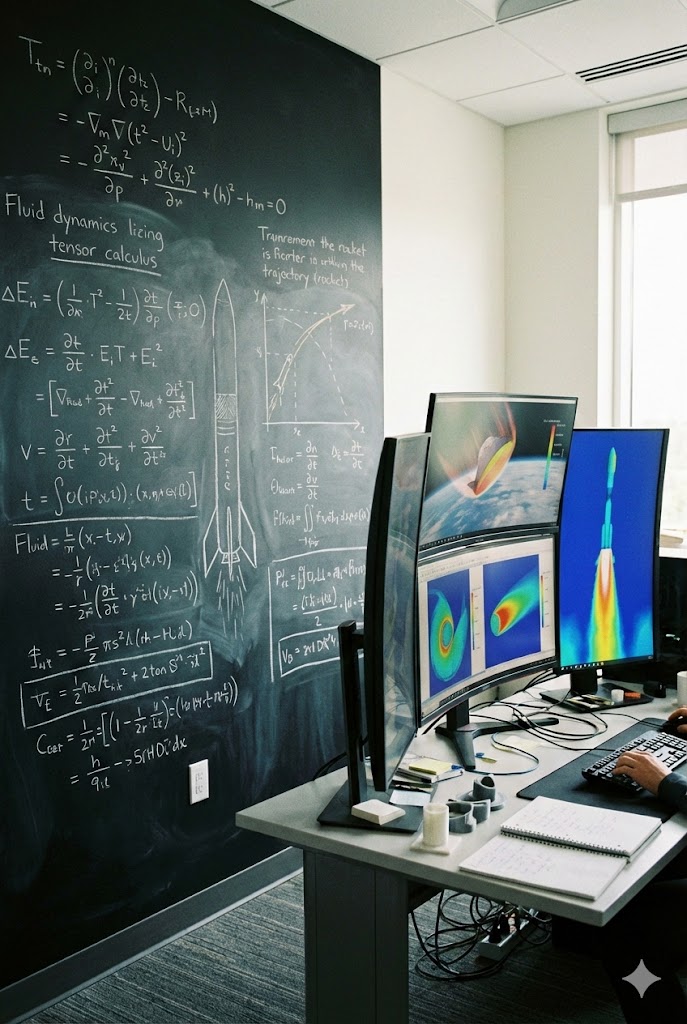
Numerical simulation of natural phenomena
Numerical solution of differential equations.
Development of propagation models in linear and non-linear inhomogeneous and/or anisotropic media
Simulation of wave propagation phenomena.
Development of algorithms and mathematical methods in aerospace engineering and technology
Formal mathematical methods and algorithms for engineering and technological development problems.
Dynamics of variable mass systems
Computational nonlinear dynamical systems
History, philosophy and teaching of physics
Computational resolution and evaluation of nonlinear dynamic systems.
Dynamics of variable mass systems with applications to technology.
Development of physical models for teaching physics, strengthened by the history and philosophy of science.
LKGA 2: Intelligent telematics systems
The LKGA of "intelligent telematic systems" allows the development of adaptable and flexible systems that fully incorporate concepts of transmission systems, software development and instrumentation with the aim of providing accessibility, ubiquity and connectivity in a transparent way to the applications that require it, taking as its axis the incorporation of various technologies and standards.
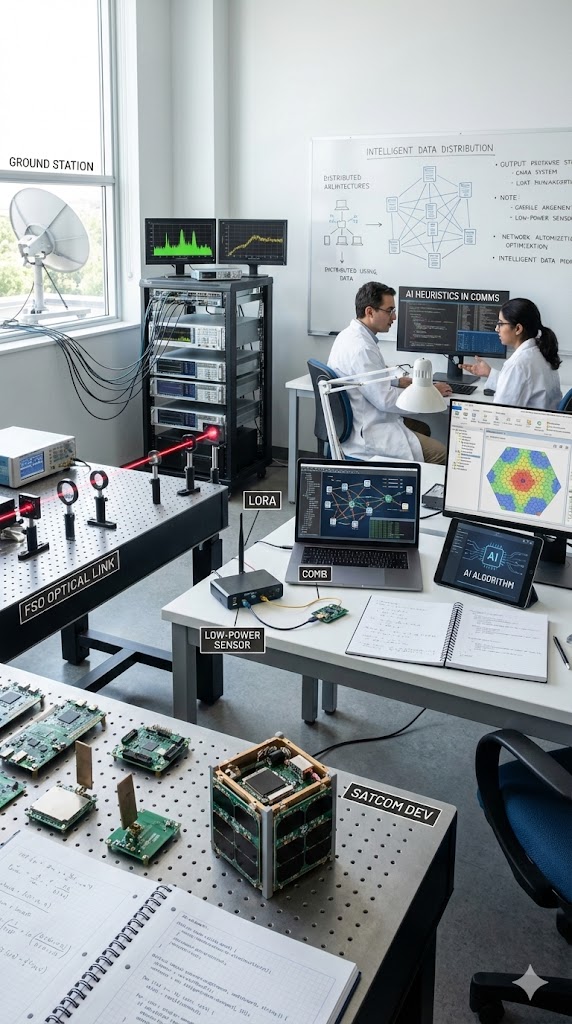
Development of satellite communications subsystem
Design and development of hybrid platforms (hardware and software) for data transmission and reception exclusively in the satellite context according to the guidelines of the International Telecommunication Union on satellite transmission systems
Space-based free-space optical (FSO) communications modeling
Modeling and simulation of the transmission chain stages for free-space optical systems, mainly for satellite applications according to the guidelines of the International Telecommunication Union regarding systems above 300 GHz
Development of space-based ground stations
Design and development of hybrid (hardware and software) reception platforms under regulations according to the guidelines of the International Telecommunication Union regarding earth stations.
Optimization of cellular systems
Development of low-power communication systems
Intelligent data distribution in communication systems under distributed architectures
Design and implementation of small-scale transmission and processing systems for data monitoring and acquisition according to the LPWAN (Low Power Wide Area Network) standard guidelines
Modeling and simulation of strategic processes for efficient transmission and reception in cellular systems according to the regulations imposed by ETSI and GSMA
Modeling, simulation and implementation of strategic processes and architectures for data distribution and routing in different environments.
Heuristics and AI in communication systems
Modeling and simulation of strategic processes compatible with artificial intelligence algorithms for distribution, routing and pattern classification in transmission systems.
Specialized software development
Development and production of specialized software in different areas and processes of transmission systems for simulation of specific stages
LKGA 3: Space Robotics
The Space Robotics Research Line focuses on the development of space systems closely linked to robotics, integrating knowledge in control theory, instrumentation, embedded systems, and sensor fusion. This line addresses the design, analysis, and validation of attitude determination and control algorithms, robust and adaptive control, as well as Hardware-in-the-Loop verification methodologies, applied to small satellites and robotic platforms in dynamic and uncertain environments.


Active Disturbance Rejection Control (ADRC)
Application of active disturbance rejection control techniques to improve the robustness and performance of control systems in satellites and robotic platforms under dynamic and uncertain conditions
Instrumentation for Space Systems.
Integration and calibration of onboard sensors and actuators, specifically designed for space missions with small satellites
Attitude Determination and Control Systems for CubeSat systems
Development and optimization of sensor fusion algorithms and techniques to determine the orientation of satellites in low Earth orbit, as well as control strategies to achieve and maintain the stability and orientation of the satellite in space.
Adaptive Control of Robotic Systems
Hardware-in-the-Loop (HIL) Verification for Satellite Control Systems
Control Theory and Applications
Development of Hardware-in-the-Loop based methodologies for the validation and real-time testing of satellite attitude control subsystems.
Modeling and control of robotic platforms with the ability to adjust gains in response to changing operating environments.
Theoretical foundations and practical applications of modern control systems in the aerospace and robotics domains.
LKGA 4: Electronic Instrumentation and Embedded Systems
The "Electronic Instrumentation and Embedded Systems" research area focuses on the development of electrical and electronic support systems for the laboratory's various research lines, particularly in the aerospace and telecommunications sectors. It encompasses signal conditioning and acquisition, as well as signal processing using microcontrollers, processors, and small- and medium-scale configurable logic architectures. It also integrates the design of power electronics and energy management systems for power generation, regulation, and supply, ensuring the reliable operation of embedded platforms in mission-critical applications.
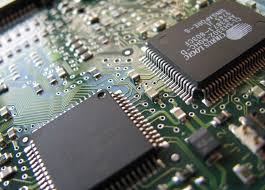
Development of satellite payloads
It encompasses the acquisition and processing of data resulting from scientific and technological experimentation, from telemetry variables and on-board image processing
Data processing distribution strategies in spatial environments
This area of expertise addresses the study and development of distributed processing architectures, where multiple nodes cooperate in data acquisition, processing, and management. It includes synchronization, communication, mutual exclusion, and fault tolerance algorithms, all aimed at improving system efficiency and scalability. It also handles hardware distribution and communication via backplane systems.
Development of satellite onboard computing systems
Design and implementation of embedded computing platforms for onboard satellite operation, considering energy consumption, mass, and volume constraints. This includes the selection of hardware and software architectures, the development of fault-tolerant systems, real-time task management, and the integration, coordination, and synchronization of subsystems.
Development of power electronic systems for aerospace engineering applications
It encompasses the generation, regulation, conversion, storage, and distribution of electrical energy. It includes the development of power converters, energy management systems, and protection strategies.
LKGA 5: Computational Mechanics
La LGAC de "mecánica computacional" es ...
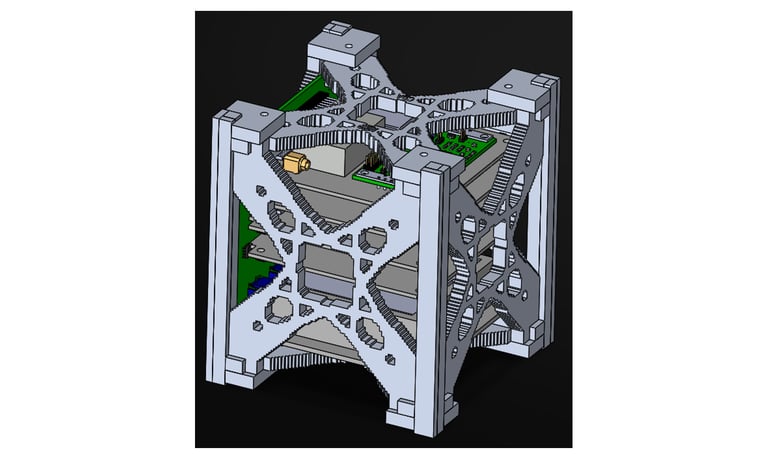
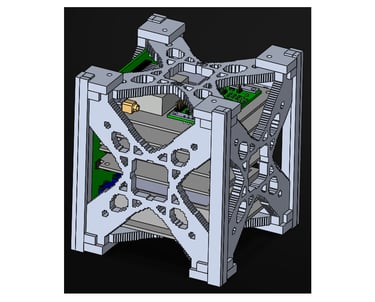
Development of satellite structural subsystems
Aplicación de técnicas de control por rechazo activo de perturbaciones para mejorar la robustez y el rendimiento de sistemas de control en satélites y plataformas robóticas bajo condiciones dinámicas e inciertas
Development of mechanical simulation tools based on the Finite Element Method
Integración y calibración de sensores y actuadores a bordo, diseñados específicamente para misiones espaciales con satélites pequeños
Strategies for structural modeling, simulation, and optimization
Desarrollo y optimización de algoritmos y técnicas de fusión sensorial para determinar la orientación de satélites en órbita terrestre baja, así como estrategias de control para lograr y mantener la estabilidad y orientación del satélite en el espacio.
Development of metaheuristic and evolutionary algorithms for structural topological optimization
Desarrollo de metodologías basadas en Hardware-in-the-Loop para la validación y pruebas en tiempo real de subsistemas de control de actitud satelital.
Contact us!
If you are interested in participating in a research project, developing your thesis, performing social service, professional internships, or collaborating on an industrial development project, this is the ideal place for you.